
Mineral Processing Reagents

-
 E-mail
xhcnlite@xinhaimining.com
-
 Call Us
008613683147042
E-mail
xhcnlite@xinhaimining.com
Call Us
008613683147042
2026-11-25 Views: 13
Warm Tip: If you want to know more information, like quotation, products, solutions, etc., please Click here ,and contact us online.
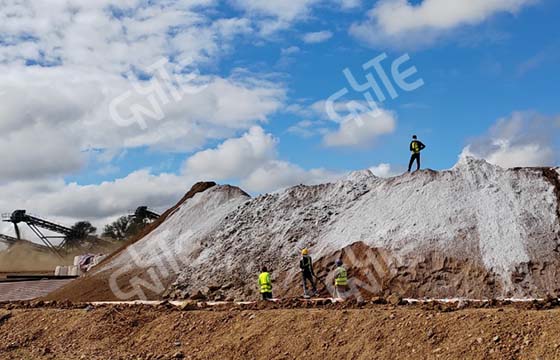
Choosing a gold leaching reagent is mostly a question of one thing: what is actually in your ore. Get that wrong and every reagent you try will look like it is failing, when really the ore is just doing what its chemistry says it must.
A clean oxide ore is the easiest case. The gold is free, the rock is not trying to fight you, and almost any reasonable reagent will pull a good recovery in a few hours. When people say cyanide "works", they are usually thinking of this ore.
What matters here is not recovery. It is cost and safety. You can spend your time asking whether a non-cyanide option will match cyanide at a lower site risk. On clean oxide, that is a fair question, and it is often a yes.
Sulfide ore is where the trouble starts, and the trouble is usually not the sulfide. It is everything that comes with it.
Pyrite and arsenopyrite do not just sit there. They oxidize and consume reagent. Arsenopyrite adds a second problem: the arsenic. A reagent that pulls the gold out of arsenopyrite still leaves you with an arsenic-loaded tailings story to deal with. So the reagent is only half the decision. The tailings treatment is the other half.
Copper is the one that sneaks up on you. A little chalcopyrite or chalcocite in the feed will dissolve alongside the gold and eat your reagent, sometimes at several times the rate the gold does. The lab sheet says "sulfur" and everyone misses the copper until the consumption numbers stop making sense.
On this ore, the question is not just "which reagent dissolves gold". It is "which reagent survives the copper". That is a different question, and it is why a bench test on your own feed is non-negotiable here.
Carbonaceous ore is the sneakiest of all. The gold dissolves fine, then the organic carbon grabs it back out of solution before you can recover it. On paper this looks exactly like a failing reagent: high consumption, low recovery, nothing wrong with the chemistry.
No reagent fixes this on its own. The carbon has to be handled first, usually with pre-treatment, or the gold keeps slipping away no matter what you add. People waste months here because the diagnosis is the hard part, not the reagent.
Refractory ore is where a lot of plants stop making progress. The gold is locked inside the sulfide lattice, or too fine to free by grinding alone. Adding more reagent does nothing because the reagent cannot reach the gold.
Here the real decision is upstream: oxidation, roasting, pressure, or fine grinding before you ever think about which reagent to use. Pick the reagent first and you have bought a tool for a job you are not even doing yet.
Whatever the ore, one thing stays true. The only number that matters is cost per recovered ounce at steady recovery, measured on your own ore, with the dosage each reagent actually needs. A cheaper reagent that needs double the dose is not cheaper. A 1% recovery drop is gold you already mined, sitting in the tailings dam.
| Ore type | The real problem | What decides the reagent |
|---|---|---|
| Clean oxide | None really | Cost and site safety |
| Sulfide | Reagent consumption, arsenic | Tailings handling, not just leaching |
| High copper | Copper eats the reagent | Whether it survives the copper |
| Carbonaceous | Gold re-adsorbs | Pre-treatment comes first |
| Refractory | Gold locked away | Upstream liberation before reagent |
Because the reagent only does one job: dissolve accessible gold. Sulfide, copper, carbon, and locked gold each block that job in a different way.
Copper. It eats reagent quietly, and the lab often reports it as sulfur, so nobody catches it until consumption looks absurd.
No. The carbon must be handled first, or the gold keeps re-adsorbing no matter what you add.
Rarely. The decision is usually upstream, in liberation and pre-treatment, not in which reagent you buy.
On clean oxide, you might get away without one. On sulfide, copper, or carbonaceous ore, skipping it is how plants lose money.
Tell CNLITE what is really in your ore, not just "sulfide" or "oxide", and share your head grade and any test data you have. The technical team can help you work out which problem your ore actually has, and which reagent, or which pre-treatment, gives you a fair shot at it.
Feel free to contact us!
 008613683147042
 xhcnlite@xinhaimining.com

No. 188, Xinhai Street, high-tech Industrial Park, Fushan District, Yantai, Shandong, China.
Please leave your message here! We will send detail technical info and quotation to you!

 Home
 Online Service