
Mineral Processing Reagents

-
 E-mail
xhcnlite@xinhaimining.com
-
 Call Us
008613683147042
E-mail
xhcnlite@xinhaimining.com
Call Us
008613683147042
2026-11-25 Views: 12
Warm Tip: If you want to know more information, like quotation, products, solutions, etc., please Click here ,and contact us online.
 The short answer is yes, in a lot of cases, but not every case. And the honest way to find out is to test your own ore before you rip out your cyanide circuit. People who skip that step usually learn an expensive lesson.
CNLITE is a gold leaching reagent built to stand in for sodium cyanide. The point is to pull the gold out without putting a dangerous cyanide drum on site, and without the detox headache that comes with it. It is not a miracle, though. It still has to dissolve the gold, and your ore still has to let it.
On a clean oxide ore, the swap is usually smooth. The gold sits where the reagent can reach it, and the numbers look a lot like cyanide. Fine gold, coarse gold, free-milling material. These are the easy ones.
Things get harder once the ore gets stubborn. Sulfide ore, high copper, carbonaceous material. These are the ores that chew up any reagent, cyanide or not. That is where a bench test stops being optional and becomes the whole point.
Do not trust a brochure. Put your own ore in two jars. One with cyanide, one with CNLITE. Same grind, same water, same time, same pH. Then measure the head grade and the residue grade. That side-by-side result tells you more than any spec sheet.
One thing people miss: watch the dosage. A reagent that needs twice the dose is not cheaper, even if the price per kilogram looks nicer. Run the cost per recovered ounce, or the whole exercise is just guesswork.
| Step | Why it matters |
|---|---|
| Same ore, same grind | Anything else and the test means nothing |
| Measure head and residue grade | Recovery is the only number that counts |
| Track actual dosage | Price per kg hides the real cost |
| Note pH and temperature | Small shifts change the result |
Here is the part nobody puts in the brochure. CNLITE and cyanide are not the same molecule, so they do not always behave the same in solution. The kinetics can feel a little different. A plant that only ever used cyanide might need to tweak the addition rate, the pH target, or the leaching time before the switch feels right.
That is not a flaw. It is just a different tool, and a different tool asks for a slightly different hand.
On easy ore, yes, often. On hard ore, maybe, but only after a real test. The answer is not a clean yes or no. It is a question your ore gets to answer, and the only way to ask it properly is a side-by-side jar test on your own material.
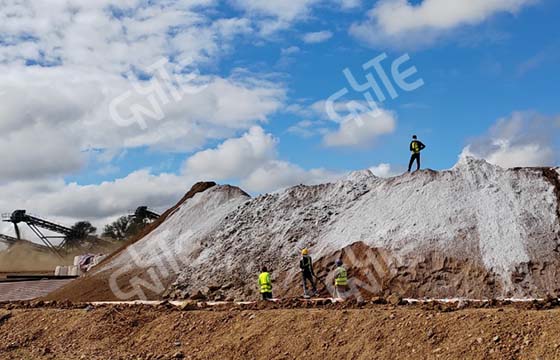
(gold-leaching-case-zimbabwe-CNLITE)
On many oxide ores, close enough to work. But treat it as a reagent swap that still needs a bench test, not a one-for-one promise.
It can, but these ores are demanding for any reagent. A controlled test is the only way to know for your material.
Head grade, residue grade, actual dosage, pH, temperature, and time. Recovery at a given dosage is what decides.
Maybe. The price per kilogram rarely tells the truth. Compare cost per recovered ounce at the dosage each one actually needs.
Check the pH, the addition rate, and the leaching time. A new reagent often wants a slightly different operating window before it shines.
If you are weighing CNLITE against cyanide, send your ore type, head grade, and any test data you already have. Our CNLITE technical team can send you the sample if you need!
 008613683147042
 xhcnlite@xinhaimining.com

No. 188, Xinhai Street, high-tech Industrial Park, Fushan District, Yantai, Shandong, China.
Please leave your message here! We will send detail technical info and quotation to you!

 Home
 Online Service