
Mineral Processing Reagents

-
 E-mail
xhcnlite@ytxinhai.com
E-mail
xhcnlite@ytxinhai.com
-
 Call Us
008613641173523
Call Us
008613641173523
E-mail
xhcnlite@ytxinhai.com
Call Us
008613641173523
 Home
Guides
Helpful Guide
Precision Engineering in Gold Heap Leaching: Maximizing Value from Low-Grade Ore
Home
Guides
Helpful Guide
Precision Engineering in Gold Heap Leaching: Maximizing Value from Low-Grade Ore
2026-03-31 Views: 7
Warm Tip: If you want to know more information, like quotation, products, solutions, etc., please Click here ,and contact us online.
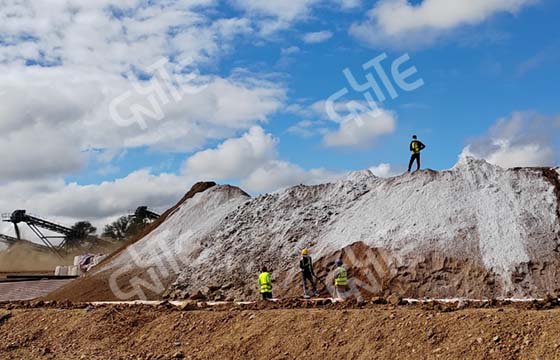
The success of gold heap leaching depends on the balance between hydraulic conductivity and chemical kinetics. It is not merely "piling rocks"; it is a precision engineering feat. If the leach solution cannot migrate uniformly through the heap, "dead zones" occur, and significant gold remains trapped in the ore.
For ores with high clay content, fine particles often migrate and clog the heap's pores, causing "blinding." Agglomeration—the process of mixing fines with cement or binders and leaching reagents to form stable pellets—is the solution. This ensures that the heap leach remains permeable, allowing oxygen and solution to reach every particle of gold.
The method of solution application significantly impacts the recovery rate. While sprinklers are common, drip irrigation is often superior in gold heap leaching because it minimizes evaporation and prevents the "channeling" effect where solution takes the path of least resistance, bypassing large sections of the ore.
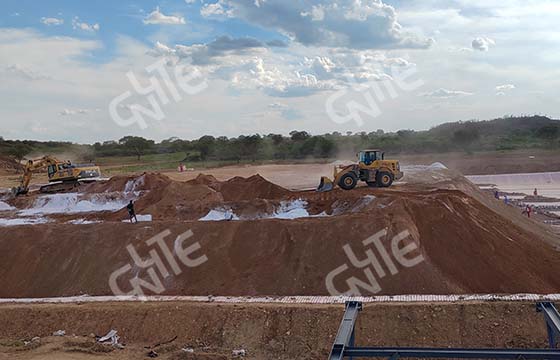
The following table highlights the difference between traditional operations and optimized strategies:
| Parameter | Traditional Heap Leach | Optimized Strategy (Cnlite Solution) | Improvement |
| Average Recovery Cycle | 90 - 150 Days | 60 - 90 Days | ~35% Faster |
| Reagent Consumption | High (due to volatilization) | Precise (Low loss) | 15% Cost Reduction |
| Permeability Rate | Unstable / Prone to blinding | Uniform / Stable | 5% Increase in Recovery |
| Environmental Cost | High (Complex detoxification) | Low (Eco-friendly reagents) | 50% Savings |
Operating a heap leach in extreme environments presents unique challenges that traditional chemicals often cannot meet.
Cold Climates: Reaction kinetics slow down in low temperatures. This requires high-activity reagents that remain effective even as the mercury drops.
Arid Regions: Water conservation is paramount. Efficient closed-loop systems and low-volatility reagents are essential for sustainable gold heap leaching.
In a heap leach environment, reagent stability is everything. Eco-friendly leaching agents are less prone to degradation by sunlight and air compared to traditional options. Furthermore, because these reagents are significantly less toxic, the cost of "closing" the heap and reclaiming the land at the end of the mine life is drastically reduced, making it easier to secure social licenses and government permits.
This is usually caused by "compaction" from the weight of the heap or an "oxygen deficiency" where the dissolved oxygen is consumed before the solution reaches the lower layers.
To prevent reagent decomposition and ensure safety, the pH should be strictly maintained between 10.5 and 11.0.
No. High-grade ores or those with very fine gold encapsulated in quartz usually require the finer grinding found in a milling circuit rather than a heap leach.
Pre-wetting the ore with reagents during agglomeration starts the chemical reaction immediately, often shortening the overall heap leach cycle by weeks.
We recommend installing sampling wells at various depths to monitor the Pregnant Leach Solution (PLS) grade and pH levels in real-time.
Ready to shorten your ROI and solve your permeability issues?
Contact us today for customized services and let our experts help you unlock the full potential of your mineral assets.
 008613641173523
 xhcnlite@ytxinhai.com
No. 188, Xinhai Street, high-tech Industrial Park, Fushan District, Yantai, Shandong, China.
Please leave your message here! We will send detail technical info and quotation to you!

 Online Service