
Mineral Processing Reagents

-
 E-mail
xhcnlite@ytxinhai.com
E-mail
xhcnlite@ytxinhai.com
-
 Call Us
008613683147042
Call Us
008613683147042
E-mail
xhcnlite@ytxinhai.com
Call Us
008613683147042
 Home
Guides
Helpful Guide
Gold Tailings Re-Processing [a practical guide to mining waste profitably]
Home
Guides
Helpful Guide
Gold Tailings Re-Processing [a practical guide to mining waste profitably]
2026-02-25 Views: 797
Warm Tip: If you want to know more information, like quotation, products, solutions, etc., please Click here ,and contact us online.
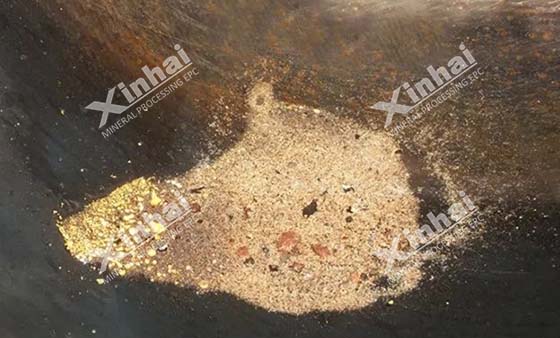
Most people assume tailings are worthless waste. They're wrong. Old tailings dams often still hold 0.3–1.5 g/t gold. At current prices, this "waste" can be more valuable than some low-grade fresh ore.
| Tailings Type | Typical Gold Grade (g/t) | Re-Processing Viability | Main Challenge |
|---|---|---|---|
| Old flotation tailings | 0.5–1.2 | High | Fine gold recovery difficult |
| Cyanide leach residue | 0.3–0.8 | Medium-High | Residual cyanide management |
| Heap leach waste | 0.2–0.5 | Medium | Poor permeability, poor reagent contact |
| Gravity separation tailings | 1.0–3.0 | Very High | Higher equipment investment |
Bottom line: If your tailings grade exceeds 0.4 g/t and you have over 500,000 tonnes, the economics deserve serious analysis.
Technology selection isn't about using the newest option—it's about matching your tailings' characteristics.
| Process Route | Best For | Gold Recovery | Operating Cost (USD/t) | Environmental Risk |
|---|---|---|---|---|
| Gravity + Flotation | Coarse gold, sulfide tailings | 60–85% | $8–15 | Low |
| Cyanide re-leaching | Oxide ores, fine gold | 75–90% | $12–20 | Medium-High |
| Thiosulfate leaching | Copper-rich, cyanide-sensitive | 70–85% | $18–28 | Low |
| CNLITE eco-friendly reagent | All tailings types, strict environmental standards | 75–88% | $15–25 | Very Low |
Practical recommendations:
Start with mineralogical diagnostics (XRD + SEM) to understand gold deportment
Run column leach or agitated leach tests—don't rely on literature data alone
If the original process used cyanide, consider switching to CNLITE eco-friendly reagent to eliminate detoxification steps
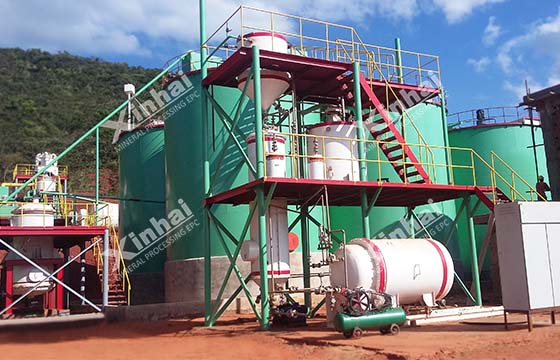
Tailings re-processing equipment differs from fresh ore plants. You must account for severe slimes content and high grade variability.
| Process Stage | Recommended Equipment | Selection Criteria | Common Pitfall |
|---|---|---|---|
| Feeding | Variable-frequency vibrating feeder | Consistent feed rate, anti-blocking | Must include trash screen—old tailings contain wood, plastic that jams equipment |
| Grinding | Stirred mill or tower mill | Grind to 90% -38μm | Avoid ball mills—old tailings are already fine; over-grinding wastes power |
| Classification | Hydrocyclone cluster | Controlled cut size | Spigots wear fast—keep spare parts in stock |
| Leaching | Twin-impeller agitation tank | Low speed, high aeration | Use corrosion-resistant lining—old tailings may contain chlorides |
| Solid-liquid separation | High-rate thickener + filter press | >80% water recovery | Size thickener drive one grade higher—tailings are highly slimed |
| Effluent treatment | Ozone oxidation + activated carbon | Meet discharge or reuse standards | Switching to eco-friendly reagents eliminates this cost entirely |
Cost-saving tip: Old tailings typically don't need crushing. Feed directly to the grinding circuit, eliminating primary crushing equipment.
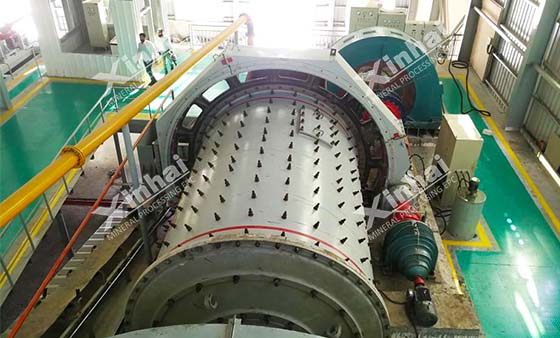
Assuming 1 million tonnes of tailings at 0.8 g/t, gold price $2,000/oz:
| Item | Figure |
|---|---|
| Contained gold metal | 800 kg (~25,715 oz) |
| Theoretical value | ~$51.4 million |
| Overall recovery (at 80%) | 640 kg |
| Actual revenue | ~$41.1 million |
| Processing cost at $15/t | $15 million |
| Gross profit before tax | ~$26.1 million |
Reality check: This is the optimistic scenario. Actual costs must include:
Tailings dam excavation and transport (if off-site)
Environmental taxes and rehabilitation bonds
Demolition or retrofit of old equipment
Q1: Do I need new permits for tailings re-processing?
A: Yes. In most jurisdictions, you must amend your mining license or apply for separate tailings utilization permits. Environmental assessments must be redone. Timeline: typically 6–12 months.
Q2: What about cyanide in old tailings?
A: If the original process used cyanide, consider switching to CNLITE eco-friendly reagent to bypass complex detoxification. Alternatively, INCO process (SO₂/air oxidation) works but adds cost.
Q3: Where do I put the new tailings?
A: Dry stacking is preferred—it reduces storage volume by 90%. If wet disposal is necessary, the finer particle size of re-processed tailings requires fresh stability assessments for dam integrity.
Q4: Is it worth it for small operations (<100,000 tonnes tailings)?
A: No for fixed plants. Consider mobile processing units or toll treatment arrangements with nearby plants that have spare capacity.
Q5: What's the biggest technical risk?
A: Mineralogical misjudgment. Why wasn't the gold recovered originally? If it's a particle size issue, solvable. If it's gold deportment (ultrafine or locked gold), recovery rates may disappoint.
Gold tailings re-processing isn't about whether to do it—it's about how to do it profitably. Choose the wrong technology, profit turns to loss. Choose the wrong environmental solution, you face shutdown.
CNLITE provides:
Free leach testwork on your tailings samples
Custom process design (gravity/flotation/leaching optimization)
Technical support for eco-friendly reagent implementation
Contact us today for your tailings re-processing feasibility assessment. Don't let your gold depreciate in a tailings dam.
 008613683147042
 xhcnlite@ytxinhai.com
No. 188, Xinhai Street, high-tech Industrial Park, Fushan District, Yantai, Shandong, China.
Please leave your message here! We will send detail technical info and quotation to you!

 Online Service