
Mineral Processing Reagents

-
 E-mail
xhcnlite@ytxinhai.com
E-mail
xhcnlite@ytxinhai.com
-
 Call Us
008613641173523
Call Us
008613641173523
E-mail
xhcnlite@ytxinhai.com
Call Us
008613641173523
2026-03-27 Views: 8
Warm Tip: If you want to know more information, like quotation, products, solutions, etc., please Click here ,and contact us online.
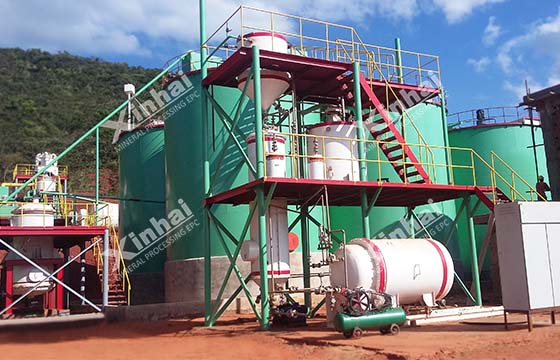
Electrowinning is the final step in hydrometallurgical gold recovery: using electric current to "pull" gold ions out of solution and deposit them as solid metal onto cathodes. No zinc powder needed, no filtration required—one less process step compared to traditional Merrill-Crowe precipitation.
The core reactions are straightforward:
Cathode: Au(CN)₂⁻ + e⁻ → Au + 2CN⁻ (gold ions gain electrons and become metallic gold)
Anode: Water oxidation releasing oxygen, or cyanide oxidation (depends on anode material)
| Parameter | Recommended Range | Consequences if Outside Range | Data Source |
|---|---|---|---|
| Current Density | 10-25 A/m² | Too low: slow deposition; Too high: rough gold layer, short circuits | Industrial practice |
| Cell Voltage | 2.5-4.0 V | Above 4V: energy consumption spikes, impurities co-deposit | Lab/Industrial data |
| Solution Temperature | 40-60°C | Below 40°C: slow reaction; Above 60°C: cyanide decomposition risk | Process manuals |
| pH Level | 10.5-12 (alkaline) | Acidic conditions: cyanide decomposition, safety hazard | Safety regulations |
| Gold Concentration | 500-1000 mg/L (pregnant solution) | Below 200mg/L: current efficiency drops sharply | Mine design specs |
| Current Efficiency | 5-10% (typical for gold) | Low but normal due to competing side reactions at low gold concentrations | Academic research |
Important Note: Current efficiency in gold electrowinning appears low (typically under 10%). This is normal. Because gold concentration in solution is low, most current gets consumed by side reactions like water reduction and oxygen reduction. Don't chase high current efficiency—focus on gold recovery rate (typically >95%).
| Cathode Type | Surface Area | Gold Loading Capacity | Stripping Method | Best Application |
|---|---|---|---|---|
| Stainless Steel Wool | Extremely high | Large | Acid dissolution or mechanical stripping | Large-scale mining standard |
| Stainless Steel Mesh/Plate | Medium | Medium | Mechanical tapping | Small-medium systems, easy operation |
| Expanded Metal Sheet | Low | Small | Direct removal for smelting | High-grade solutions, rapid turnover |
Anode Selection: Stainless steel is cheap but corrodes quickly; lead alloys are durable but carry lead contamination risks; mixed metal oxide (MMO) coated titanium anodes are most expensive but last longest, and can oxidize/degrade cyanides.
| Comparison Item | Electrowinning | Merrill-Crowe (Zinc Precipitation) |
|---|---|---|
| Suitable Solution Grade | High grade (>500mg/L Au) | High grade with large flow volume |
| Silver Handling | Can handle, but requires larger capacity | Better suited for high-silver solutions |
| Chemical Consumption | None (electricity only) | Requires zinc dust, lead salts, flocculants |
| Product Form | Cathode gold sludge (~65% Au) | Zinc-gold precipitate (more impurities) |
| Subsequent Processing | Acid washing then smelting | Zinc removal required, more flux consumption |
| Footprint | Small | Large (needs deaeration tower, filtration) |
| Automation Level | Easy to automate | Multiple manual operation steps |
Decision Guide: If your pregnant solution comes from CIP/CIL elution (gold concentration 600-2000mg/L), choose electrowinning. For low-grade, high-flow heap leach solutions, consider carbon adsorption or Merrill-Crowe.
Issue 1: Sudden Current Drop
Check if cathode is "blinded" by gold layer (passivation), needs cleaning
Check for solution short-circuiting (suspended carbon or metal particles)
Issue 2: Uneven Gold Deposition, "Gold Trees" Forming
Current density too high—reduce to below 15 A/m²
Uneven solution flow—install distribution headers
Issue 3: High Impurity Content in Cathode Sludge
Copper and zinc not fully removed from pregnant solution—add pre-purification step
Reduce cut-off voltage to avoid approaching impurity deposition potentials
Key integration points for CNLITE's thiosulfate/amino acid-based leaching agents with electrowinning:
| Comparison Item | Cyanide System | CNLITE Eco-Friendly System |
|---|---|---|
| Pre-Electrowinning Treatment | Standard carbon adsorption-elution | Same, but eluate composition differs |
| Solution pH | Strongly alkaline (10.5-12) | Near-neutral or weakly alkaline—confirm optimal pH |
| Anode Reactions | Possible cyanide oxidation | Gentler, reduced anode corrosion |
| Gold Deposit Morphology | Dense | May be more porous—adjust current density |
| Barren Solution Treatment | Cyanide destruction required | Direct recycling or simple neutralization |
Critical: When switching to CNLITE, run pilot tests to determine optimal current density. The electrochemical behavior of eco-friendly agents differs slightly from cyanide, but existing electrowinning equipment usually requires no modification.
Q1: Can electrowinning treat raw ore directly?
No. Electrowinning only processes pregnant solution—ore must first undergo leaching (heap leaching, tank leaching, or CIL) to dissolve gold into solution.
Q2: What's the purity of electrowon gold sludge? Does it need secondary refining?
Cathode sludge contains approximately 65% gold, with the remainder being steel wool substrate, silver, and trace copper. Requires acid dissolution to remove iron, then smelting to produce 90%+ crude gold, which goes to refineries for electrolytic purification to 99.99%.
Q3: Can small mines afford electrowinning?
Yes. Modular electrowinning units (1-5 cells) cost approximately $5,000-$15,000, suitable for projects producing <100kg gold annually. Cheaper than building Merrill-Crowe deaeration towers plus filtration equipment.
Q4: What's the energy consumption of electrowinning?
Approximately 10-20 kWh/kg gold. Sounds high, but gold value is high—electricity cost is minimal. Switching to high-frequency switching power supplies can save 15-30% energy.
Q5: Can electrowinning barren solution be recycled directly?
Yes. Barren solution contains cyanide (or CNLITE eco-friendly agents) and returns directly to the leaching circuit. This is electrowinning's advantage—closed-loop solution circulation, no wastewater discharge.
Need customized electrowinning system design? CNLITE's technical team provides full-process services from lixiviant selection to electrowinning parameter optimization. Send your ore analysis report, and we'll provide targeted gold extraction process solutions and equipment configuration recommendations within 48 hours.
 008613641173523
 xhcnlite@ytxinhai.com
No. 188, Xinhai Street, high-tech Industrial Park, Fushan District, Yantai, Shandong, China.
Please leave your message here! We will send detail technical info and quotation to you!

 Home
Home Online Service